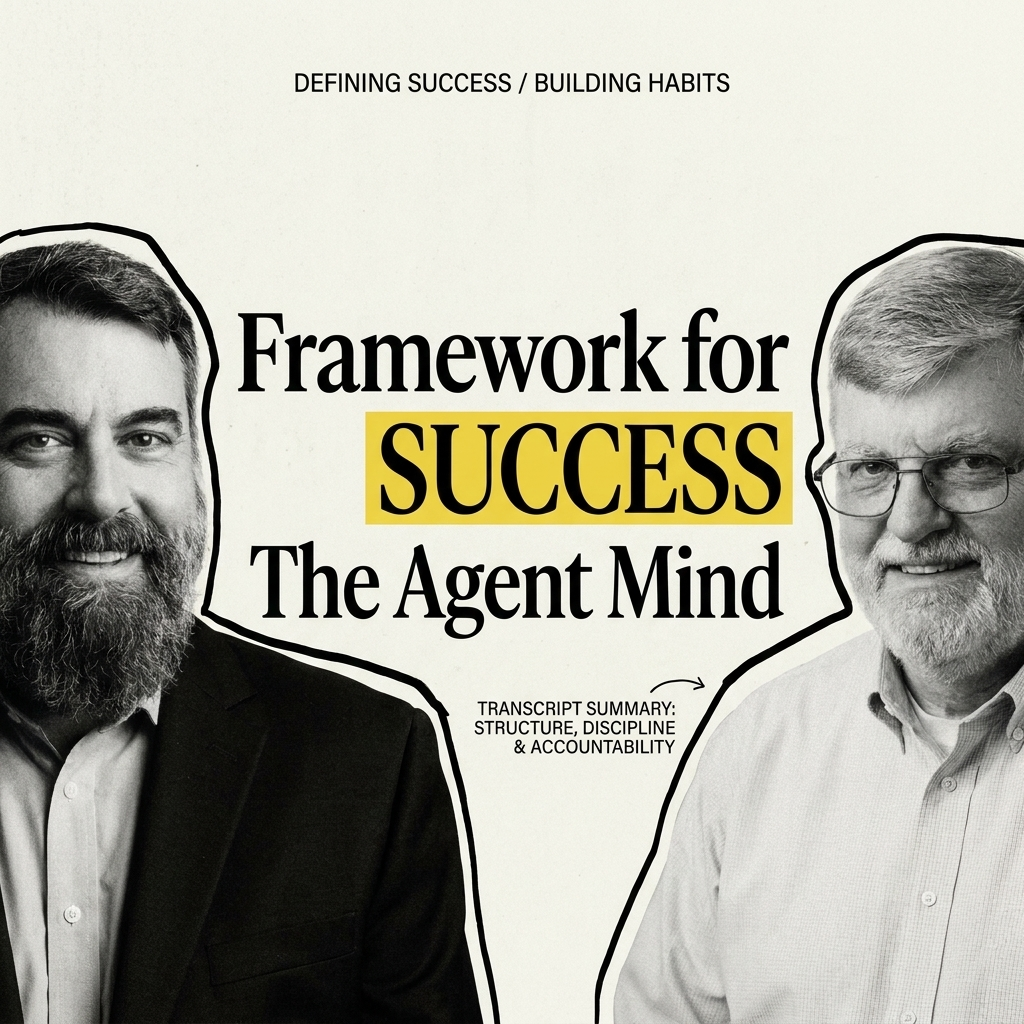
Episode Transcript
[00:00:00] Speaker A: This is not a drill.
[00:00:03] Speaker B: This is the Age of Mine podcast.
Back again with the Agent Mind podcast. Thanks so much for joining us this season. Season number three, it's turned out to be a pretty fun and amazing season. We got so much in store coming up.
I'm gonna bring on Frank Warren, our co host for this season.
But, but let me just ask this question to everybody that's listening.
If you had a framework as a new agent, how different would your business be today?
So we're going to answer that question. Look, what, what does a framework look like for new agents, for stuck agents and even for agents that might be trying to learn AI and try to figure out this new world of, of this very quickly changing landscape of technology. So we're going to get into that. If you think that you need a little more structure than is the episode for you with that. Frank Morin, my co host for the season three, thanks so much again for, for coming on. I love the contribution that you're bringing. Excellent. So get, yeah, kick us off, man. This is, this is your, this is your wheelhouse.
[00:01:10] Speaker A: Well, good morning, tj. I hope you're doing well today and thank you for that introduction. I'm excited to be here. This is going to be a fun topic today.
I enjoy learning. I also enjoy helping other people learn as well. And I've over the years have helped a number of new agents kind of get started in the business. I think if you can have a really good foundation on the front end, that's going to greatly enhance the likelihood of somebody creating a business and a career that they love and enjoy.
So we're going to talk about how to get started the right way today. So as TJ said, this is going to be a framework for people to consider and, and it's been a while since I was a brand new agent. I got into this business over 11 years ago. It's kind of funny how quickly the time flies. So I'm reflecting on, based on my experience, but also what I've seen other agents do.
I think the first thing is a mindset shift. A number of people are like myself and tj who got into this business and it's at least their second career, maybe it's their third career.
Real estate is unlike anything else. It's, in a way, it's a blank canvas. I came from a corporate world where I showed up to work at 7:30, I was finished at 5. Sometimes I had to take work home with me. But there was parameters around my activities and how I spent my time There are no parameters in real estate. You are starting with a blank canvas and you can go in any direction you want.
And what I observed in myself and others as well is not having that structure is a really difficult thing to adjust to.
There are a lot of times I would find myself watching the latest Netflix series instead of making phone calls or learning something new or going out and meeting with people.
It's easy to do because you don't have a ball standing over you.
So that's probably the biggest thing I want to stress is you've got to change your mindset. You're going from an employee, perhaps in your previous career, to now you're a business owner. Your business is based upon your ability to help people buy or sell a house. And there's a lot of work that goes into that. So you have to maintain a level of discipline, so self discipline, actually, to make sure that you are doing the right things as you're moving forward.
[00:03:42] Speaker B: Yeah, 100%.
I mean, you said something there that, that really, that's one of the things I did not necessarily realize to the extent that I should have.
I mean, hindsight's 20 20, but going from I was at a W2 job, I was working for somebody else. I was a manager, I was managing people, I was managing systems and PNLs and all that stuff. In the restaurant business, however, you had a structure. I had to be there on time.
I had a number of hours that I had to work. Often it was extended in the restaurant business, if anybody knows that, that world. But there were numbers and metrics and expectations that were already there when I was plugged into the job.
That when you start as a real estate agent, virtually none of that exists. I mean, it's out there, but you got to know what you're looking for. You have to, you know, you really have to work at building a framework. And I think that's where a lot of people go astray.
[00:04:40] Speaker A: Yep.
So the next thing beyond a mindset mindset shift is the learning curves. And what's interesting about this business is there are so many learning curves in different areas that are on their own, unrelated.
So my previous career was in the investment world and I had to learn a corporate environment. I had to learn more about fixed income instruments. I had to learn more about balance sheets and financial statements.
In real estate, you've got so many different things that you have to learn about. I would argue contracts should be the first thing. We are helping people navigate through a very complex process, either selling or buying a house.
And if you don't know the contracts well, there's a possibility that you're going to give bad advice and a mistake on a contract could be a three figure, a four figure or a five figure problem for you.
But more than that, it's going to damage your reputation. And that's a very hard thing to overcome. If people have no confidence in your ability to help them navigate this process, they're not going to hire you again.
You know what, they're probably going to go out there and tell their family and friends to stay away from you. So if you're getting into the business, I would strongly encourage you to spend some time learning the contracts. And I would suggest that you get multiple teachers to help you learn the contracts. Maybe you're in a franchise model that has ongoing education, go through one of their contracts classes, but then maybe go to your association and get somebody else. Because everybody focuses on something different and maybe has a little bit different interpretation of the contracts. So if you're just getting started, that's the first thing. But then you have systems. You know, we have this MLS system and it can be a little bit complicated to navigate. Once you learn it, it's really easy. But there is a learning curve there.
Here in Tennessee, we have something through the state association in terms of the electronic signatures. There's a learning curve that goes into that.
Next thing is your markets. There's a huge difference in my market in Memphis between downtown Memphis, Midtown, East Memphis and then the various suburbs. You've got to know the difference between what happens houses are going for in one area versus another. So learning the markets is also a very complex process.
Next is the actual structures of the house itself. You need to be able to help advise somebody about roof and heating and air exterior foundations. I mean, there's a long list of things you need to know about the actual structures. And then we haven't even talked about the properties themselves, zoning requirements, et cetera.
What about advertising and promotion? We have to be able to communicate with the general public in a way that will grab their attention so we can promote our listings. But more importantly, we need to be able to promote ourselves and help people have a sense of confidence and believe in us. So they decided to hire us.
What about negotiating? Negotiating is not easy.
And I remember early on I made some mistakes and people who are more seasoned in the business probably took advantage of that.
So what I've just shared, kind of like a tip of the spear in terms of the various learning curves and what I hope you picked up on is a lot of these things that we need to understand and know are on their own, completely unrelated. And so there's going to be areas of growth in a lot of different areas or a lot of different things. That's what excites me. That's what I love about real estate, is it's almost like a new thing I need to learn every day, every week, every month and every year.
[00:08:37] Speaker B: Yeah, you almost scared the britches off me.
[00:08:41] Speaker A: Yeah.
[00:08:42] Speaker B: Like, what do you mean?
People aren't going to refer me because I made a mistake. So don't, don't overthink that as you want to throw that out there. Like, you're, you're absolutely correct. Like, you're. Especially if you're new or if you don't have a lot of business right now, now is the time, because you have the time to really read those contracts and understand what those contracts mean and all the nuances of the contracts because they're written by lawyers. Like, I'm, I'm part of the Realtor board in Georgia.
The contracts, the forms that we use are written by lawyers for the Georgia association of Realtors. So you have to be able to understand and interpret that as the way that they're meant to be interpreted. And there's so many different exhibits and amendments that you can use in a, in a purchase and sale agreement or even a broker, you know, client agreement.
There's, there's just so many things that you just, you don't have to know it all from. You don't have to memorize it, but you have to understand what the clauses mean and, and all that. And I can tell you, the more that you know about the, about how to write contracts and what amendments to use and what clauses to use or special stipulations, the more skilled you'll be at negotiation and the more set up you'll be to serve your clients.
Meaning I think after this, the past couple years, when it was the wild Western Covid and, and you know, things were going at like 50, 70,000 above asking and waiving appraisals and all that, that's really when I learned how to do an escalation clause and that one that won some, some contracts. And if I hadn't, if I hadn't dug in and really on, made a purpose to understand that, I probably wouldn't have been able to use that, and I probably would have lost those deals for my clients. So just one little example.
I mean, education and market knowledge. You should just, you should know the market that you're working in.
It's very simple. In your MLS hot sheets and all that stuff, we get down to the minutiae what all that stuff is. But the, the, I hope everybody kind of understands that. Just the, the basic, the basic knowledge of your market and what you need to do to help your clients.
[00:10:58] Speaker A: So, T.J. you raised a point. And I want to emphasize.
I don't want to scare anybody away. Yes, I listed a list of various things that we really need to have at least a general understanding, if not a proficiency in. But they don't all need to occur within the first six weeks after getting your license. There's going to be ongoing learning throughout your entire life.
I've taught a class at my previous brokerage about surviving the first five years.
And one of the things I would encourage the other agents is to be a sponge and then to lean in. What I meant by that is if you have a sponge in your kitchen, it absorbs all the liquid it comes in contact with.
So try as you're going through your business and your life just trying to learn at least a foundational level of knowledge about everything that we have to touch.
But then we cannot be experts in everything. And so what I next I had a slide, it was during the Winter Olympics, and that I don't know the name of the event, but where they're going down, skiing down this giant ramp, and they're leaning forward once they exit the ramp, trying to see how far down the hill they can go, but they're leaning almost vertical with the skis.
That is an example of you need to figure out what you can lean into, figure out who you are and where your strengths lie.
I'm a big believer in doing just a few things at an exceptional level and then outsourcing as much of the other stuff as possible.
And so general understanding. But then figure out where you need to spend most of your time and money on the contracts. Do we have time for me to share a quick story?
[00:12:43] Speaker B: Yeah. 100%.
[00:12:44] Speaker A: Okay. So early on in my business, I was the listing agent of a house in Memphis. That was about 150,000.
The buyer's agent submitted an offer on their behalf. She was a multi decade level of experience.
And in the special stipulation she put in there, the buyers asked for 3% of the closing cost.
Well, the problem is the closing costs are about $7,000. Three percent of 7,000 is $210.
What they meant to say was 3% of the purchase price, which was roughly 150,000, which would be $4,500.
I met with the sellers, explained to them this is my interpretation of the language and the contract.
But I think the spirit is this.
They're good folks. My sellers were good folks, they understood it. They didn't want to create a problem later on. So they agreed to basically do 3% of the purchase price, not 3% of the closing expenses.
So we had a good transaction from there. We got the deal closed. And at the end I was having a follow up conversation with the other agent and I said, oh, by the way, in the original offer, this is the language you put in here. This would be how we could have interpreted that this is what the result would have been if we had held firm to that interpretation.
And her response to me, TJ was well, this is the way I've always done it.
And so that's the problem is we get kind of this tunnel vision in terms of how we do things.
So always be open to learning new things. Always be open to being wrong in your interpretation of something.
Because in that situation, $4,500 versus $210. Don't you think those buyers would have been very upset at the closing table?
[00:14:38] Speaker B: Oh yeah.
[00:14:38] Speaker A: Realized they needed to come up with almost 4,300 additional dollars than they were planning on, all because of an error committed by their agent.
[00:14:48] Speaker B: Yeah, let me, this is good. I'm just going to interject here for a minute because I just had a conversation earlier today, matter of fact, about the, the work that we do that some agents interpret as like it should be the other side's job to do. Right. Which is like, I just think that's this misguided thinking. It's just like, just do everything you can to get the deal done.
So imagine if you had said, oh great, we're going to get one over on them and they're only going to be, they're only going to be paying 250. And I really, I did a great thing for my sellers and all that stuff. But the reality of it is, and this might be an extreme case, but extreme. Get towards the, they're going to be under contract for a month.
Get towards the closing table. Somebody's going to realize that it's only 250 and the deal is going to go in the toilet and you're going to be backlisted. Now was that a good, was that serving your client? Was that having your client's best interest in mind?
Absolutely not. Although on surface level it's like, oh yeah, I'm saving them thousands of dollars. But in reality, probably hurting and costing them thousands of dollars because of the going back on the market and all the costs associated with that.
[00:15:52] Speaker A: But yeah, not everybody's got 4, 300 additional dollars lying around.
[00:15:57] Speaker B: Right.
[00:15:57] Speaker A: There's a possibility that the set of buyers would not have been able to close on that transaction, and we would not have found that out maybe to the end. And therefore, my seller clients would have had the house off the market for a month, gone through this lengthy process of instruction, inspections, waiting for the appraisal title to clear, and then we had to start the whole process over.
[00:16:20] Speaker B: Yeah, absolutely.
[00:16:23] Speaker A: Last thing I wanted to kind of talk about, TJ is, you know, we talked about how the different learning curves and how to go about building a framework for new agents.
I want to talk about lessons and maybe what we would suggest for somebody who's just getting started or has been in the business for just a brief period of time, first off is create realistic expectations.
There have been occasions where I've seen an agent come in and they do 10 deals in the first few months, and they're just hitting the road or hitting the ground running, but that's not been what I've seen. It's pretty much a slow burn. It takes a long time to build this up.
Realistic expectation might be three to six closings your first year, and then 10 your second year.
If you're the exception to that, great. But that would be what I would suggest somebody to think about is what would be a realistic set of ideas or expectations for you going into that first year.
[00:17:27] Speaker B: Yeah, that's one of the biggest things I think is why people fail, is that.
Well, I mean, in general, businesses in general fail, whether they're in real estate or. Or any other business, they fail because they don't have enough capital to sustain through that those first couple of years.
So that's kind of what. What we're implying here is like your. Your revenue is not going to be.
I mean, there are exceptions, like you said, but they're outliers.
The. The typical result of.
Of your first year is a lower transaction count. Lower.
[00:18:03] Speaker A: Absolutely.
[00:18:04] Speaker B: And even lower average sale price as well. So you can. You have to. Have to build up to that higher sale price, higher volume, higher production.
So. Yeah, so making sure that you have the. That you at least know going into it, that, you know, you have to have a little bit of savings.
If someone came to me today and said, I have zero money, I'm. I'm barely making rent, I'm barely making my mortgage, but I'm Going to quit my job and get into the, and get into real estate, start selling houses, I would say. And my first question, like, how many, how many people do you know? How many, how big is your sphere? And hey, I think I would hang on to your job a little bit, maybe go part time. And then let's, let's talk about what that looks like, what it actually looks like, because it is, it is a big eye opener. Even for someone who knows what to expect. It's still like you can struggle.
[00:18:54] Speaker A: Absolutely. The second lesson I would suggest or offer is you need to have the right people helping you.
As we talked about, there's a huge number of things you've got to learn, and expecting your managing broker to help you navigate through all those is probably not realistic. He or she is overseeing other agents, maybe they're also in production.
And having them relying on them to do all the hard work of helping you learn the business, probably not going to be a good outcome.
What I would suggest is hiring a good mentor or coach to walk you through this business.
And anything of value is going to have a cost associated with it. Maybe you don't have the money to hire a coach, but you can maybe start a relationship with a very successful agent to mentor you. And you've got to provide something of value.
Maybe you're the one who goes and picks up their signs and their lockboxes when a transaction closes. Maybe you're the one they call on to do the open houses on Saturday afternoon or Sunday afternoon that they don't want to do.
Maybe you're the one who's going to show the agent.
Excuse me, Maybe you're the agent who's going to show their clients a house in an area they can't get to or really don't want to invest the time to drive out to that area.
So there's different ways for you to provide value that's going to offset the value they're providing to you.
Certainly if you want to hire a coach and you've got the financial resources to do so, that would be a great way as well.
But it's going to cost you either time or money to learn this business.
I would suggest you go ahead and pay that price early on as you're trying to grow.
[00:20:44] Speaker B: Yeah, 100%. And here's one thing that I wish I had done.
And because I, I was kind of intimidated to ask, you know, a, a broker or a, another agent in my office or somebody that I saw as a successful agent, I was a little intimidated to kind of try to pick their brains. They're busy. You know, if they're successful, they're probably pretty busy, or at least they look like they're busy when they're working because they.
[00:21:09] Speaker A: They're managing their time like they're busy.
[00:21:11] Speaker B: Yeah.
So here's what I would have done. This is just a suggestion. This is. I guess this is part in theory. I don't like to live in theory or give advice based on theory. However, I believe that this would work if you were to offer to drive somebody around for a week so that they could work and get. And make calls and work on their computer while they're going from house to house or appointment to appointment.
You're going to get the best education that you could possibly get, I believe, because you're going to be. You're going to hear their conversation, you're going to have conversation with them, and then they're probably going to invite you in to listen in on their appointments.
You would think in theory. So that sounds like a good theory. If somebody out there does it, let me know. I'd love to hear the results on that. But I just think that that would be a good idea. You know, make sure it's somebody that is. That's. That's producing and going on appointments and stuff like that. Because it'd be very easy to slide into a. Let's go get lunch and talk about sports.
[00:22:12] Speaker A: That's an interesting idea. I've never heard anybody bring up. Be their chauffeur and drive them around.
[00:22:18] Speaker B: I've done it.
[00:22:19] Speaker A: I don't know anybody who's done that.
[00:22:21] Speaker B: I haven't done it in real estate, but I've done it for something like I want to get involved with. I'll just, you know, hey, oh, hey, I'll drive. You know, that kind of. I'll drive. And then they. They take phone calls and they're. And I just listen and I ask them questions about, you know, not prying questions, but just get them talking about what they're doing. And. And, you know, you. It's a great education, I'll say that. And one other thing also.
Yeah, I know you're about to say something, but let me get this out before I forget.
It's your. I heard Jackie Labertino, who's a. A broker down in Destin, Florida, she was on a podcast the other day, and I heard her say that it's during your working hours, like have a clock in hour and clock out hour.
If you are on your way to an appointment, you are working so your time is best used listening to a podcast like the Age of Mind, just throwing that out there. Listen to something, something that's feeding your knowledge rather than listening to, you know, a, a fluff podcast or listening to your favorite music. That's for time off when you're going to an appointment, coming from an appointment, going to a closing, going to an inspection, that's the time to, to educate yourself. And as I think it was Zig Ziglar always said, like, that the automobile, university, like just audiobooks, podcasts, just consume that stuff. And because a lot of people think a mentor has to be like a physical, in the flesh person that you can have a conversation with. But there's. There's a ton of people out there that have. Some of them are dead and gone that I consider to be mentors just because of the, of the knowledge, like Jim Rohn and Zig Ziglar and those guys, like, they're just, they're just full of, of great information that, that if you're, if you're consuming that content, you're. You, there's. You have to really work hard to fail, put it that way.
[00:24:13] Speaker A: Well, I appreciate that. I mean, TJ just gave us a great example.
You can't expect somebody to pour into you and get nothing back, right? So it's got to be some reciprocation. Either you're writing a check to them or you're providing a service to them. So if you're going to find an agent to mentor you or coach you, you've got to do something back to make sure that relationship is worthwhile to them.
And then the third lesson I wanted to highlight is do the work. You know, we started off talking about a change in mindset. I shared a story how I became proficient in Netflix series back when I first got into the business.
[00:24:49] Speaker B: Cobra Kai.
[00:24:50] Speaker A: Yeah, well, this would have been before Cobra Kai, but.
But yeah, it is really easy to not do anything and not be productive, but you've got to do the work. So whatever, whatever you're going to do to build your career, you've got to be consistent in it and do it every day. Whether it's making phone calls or producing content or reaching out to people, you just got to do the work. And so that's what I would encourage you to focus on, is have realistic expectations, get help from somebody, and then do the work.
Tj, that's all I've got.
[00:25:31] Speaker B: Yeah, I mean, I'm just going to kind of try to put this all into a nice little package. We're talking about framework here. So just to recap, because if you, if you're listening right now and you're kind of like, well, yeah, all that stuff sounded good, but how do I put it into practice?
So just to recap real really quickly, it's.
We're talking about a mindset shift. Is the, is the, the number one, you got to have kind of a paradigm shift of that. I am, yeah, my own boss right now. And yeah, I got into the real estate business because of the, my. I wanted a flexible schedule. That's my favorite. I wanted a flexible schedule, which you can have a flexible schedule, but that means you have to be very strict about your schedule. I don't think that that, that gets correlated all that much. And then like, you have to be, you, you have to be live and die by that schedule in order to have a flexible schedule. Otherwise people start. Put things on your schedule that you didn't intend to be there.
So that mindset shift and then learning is huge. Consume, consume, consume.
All the stuff. When you're on the clock, in quotes. When you're on your clock. Learn. Learn the contracts. Learn what a house looks like. Go to your inspections. Especially at first.
Talk to the inspector. That's how, that's how I learned like how what a, how what a systems in house were. When you, if you told me a house had a system before I got into real estate, I'm like, what do you need a system?
What systems do house have? So, yeah, they got system, roofing system, foundation system. There's lots of systems. So that's the other thing. That's the second thing is, is learning consuming information to make you better, more knowledgeable as an agent, you know, serve your clients better.
And they, and they make you building the plan, the, the framework of success. Build that plan. We talked about that in the last episode.
You have to have a plan for success. And it goes back to that, that schedule. If you're not, if you're not in, you're not the master of your own schedule, somebody else is going to be. And then that's, that's a recipe for disaster.
So in essence, Frank, man, another great, great dropping some wisdom on us.
I appreciate you. If you this would. I suggest the listeners out there go to the reagent hive.com, get on the newsletter.
The real estate agent Hive is kind of our, basically the production production company. It's not really a production company. It's a community for agents where we collaborate together. Production company production. Yeah.
I'm moving us up in the world.
So the the Age of Mine podcast, it's a little bit older than the Hive community, but it's still, it's I consider it part of the hive community. So the hive community is a larger place for agents to just get together and collaborate, because collaboration over competition is always better, always wins. So go to the agent, the reagent hive.com Sign up for the newsletter. We're going to have resources. Anytime we talk about something that you can go to download, we're going to push it out through the newsletter the following day. So that's the best way to to stay connected and learn about what's going on in the hive and on the on the Age of Mine podcast. So, Frank, thanks again. Another great episode, man.
[00:28:40] Speaker A: Great. Thanks, TJ.